Free AI mock interview
Practice the interview for the job you applied to.
Raise turns the job ad into the questions you are likely to face, then gives written feedback on each answer: what works, what to work on, and which steps of your method are missing.
- Built from the job ad
- Written feedback on every answer
- STAR, CAR, Minto, MEDDIC, SPIN
- Free plan
From the job ad to your next answer
Four steps, at your own pace, before the real interview.
Add the job
Add the role you applied to, from its link or by hand.
Get the likely questions
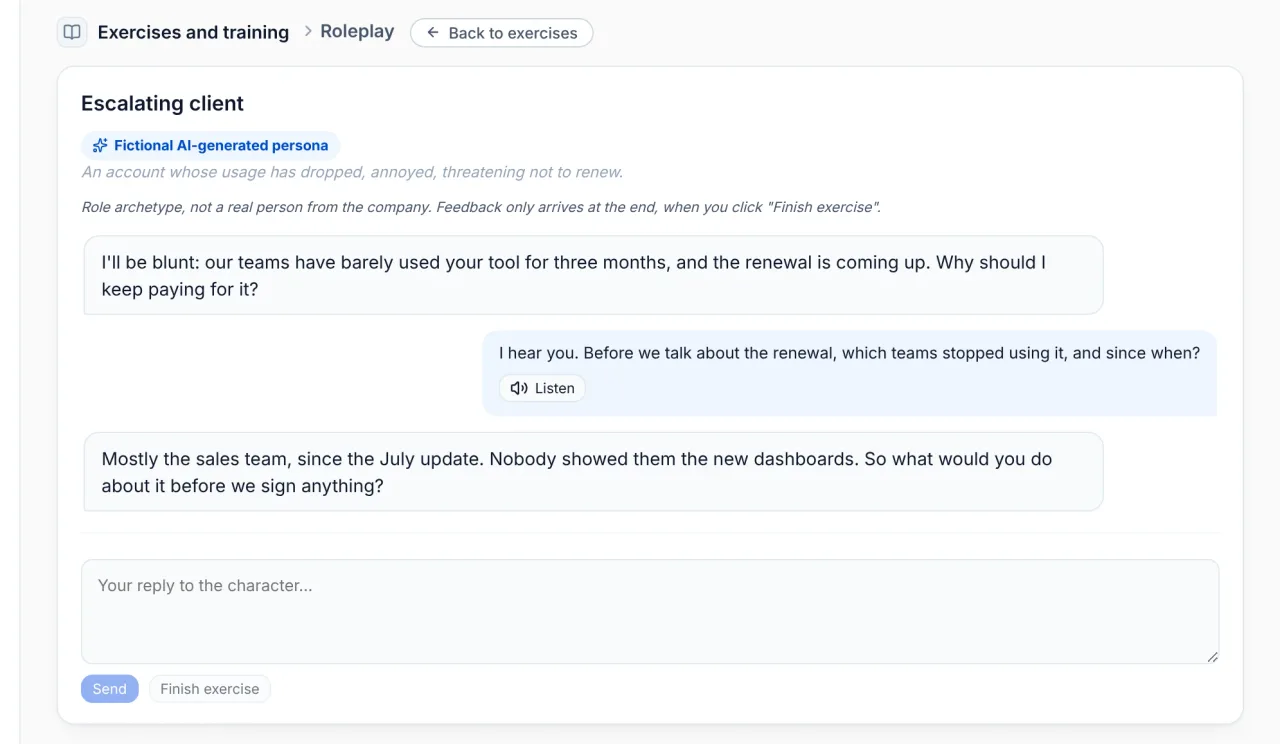
Raise reads the job ad and your profile and suggests the questions you are likely to be asked.
Answer in writing
Type your answer the way you would say it. Raise can follow up with a question, as an interviewer would.
Read the feedback
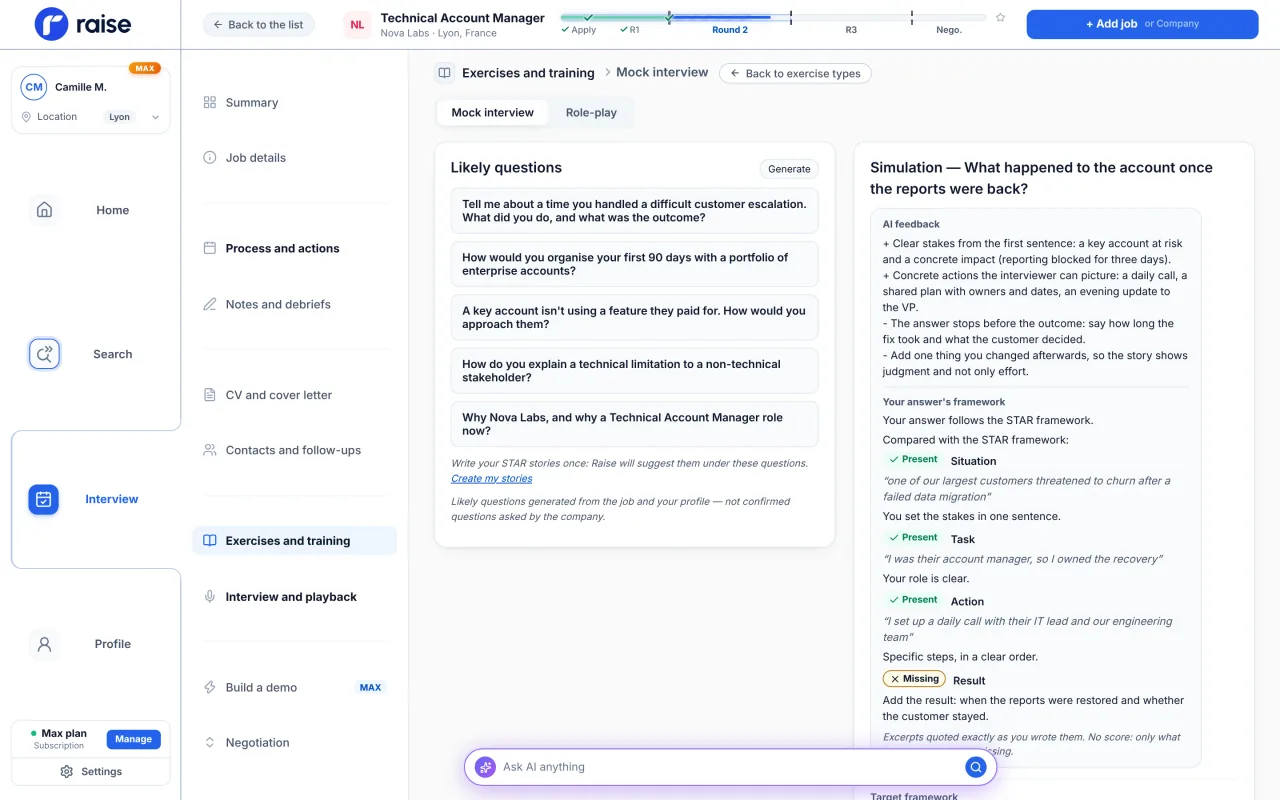
Strengths, points to work on, and each step of your method: quoted from your answer, or marked as missing.
Written feedback
Feedback quoted from your own answer.
Choose a method, or let Raise recognise the one you used. Each step is then checked: when it is there, Raise quotes the words of your answer that show it; when it is missing, it tells you what to add.
- Checked quotes. A step counts as present only if its quote is found word for word in your answer.
- No score. No mark out of 10 or 100: only what is there and what is missing.
- Always labelled. The feedback is marked as AI feedback, every time.
Likely questions
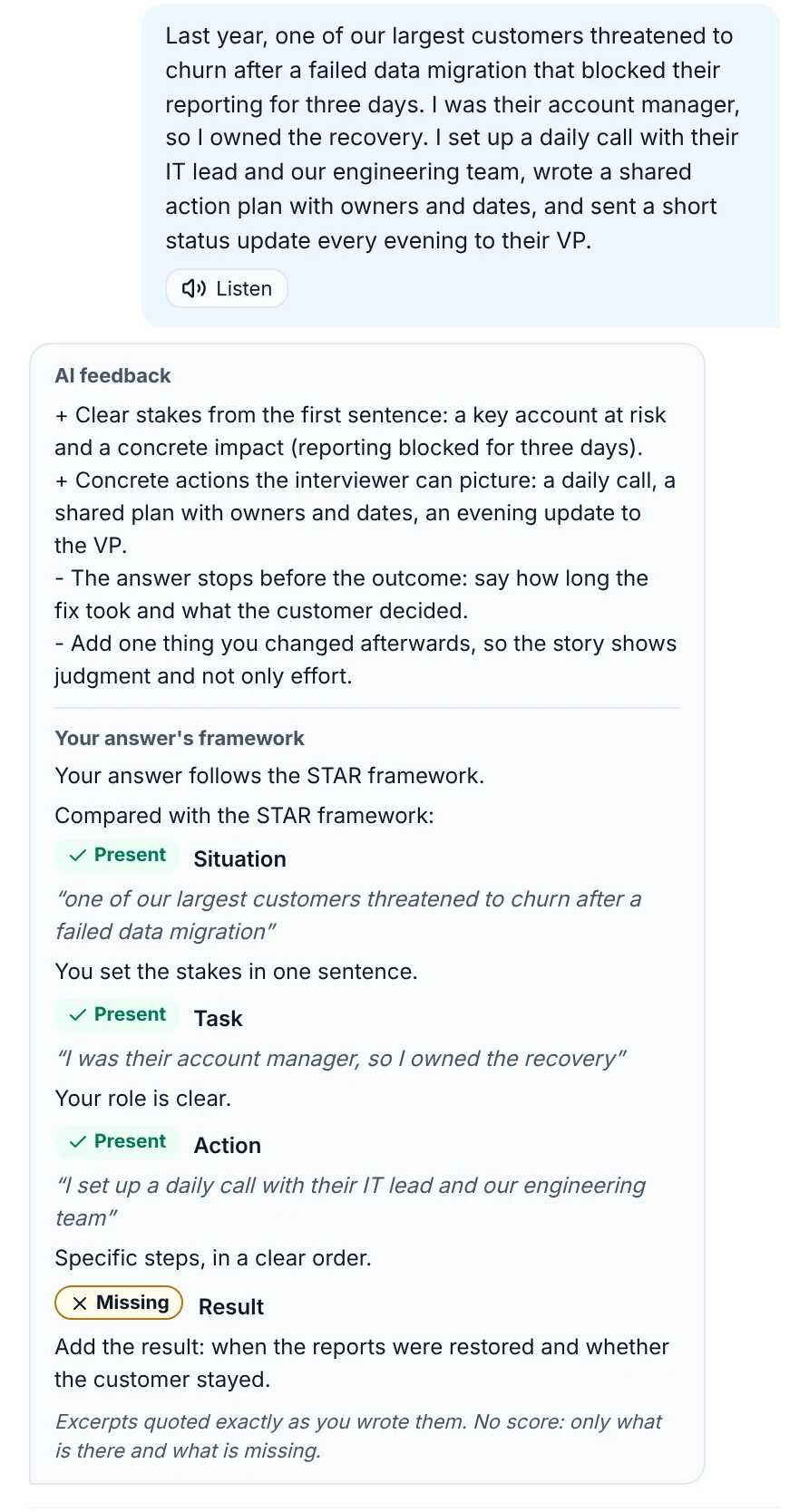
Questions from this job ad, not a generic list.
The questions follow the role, the company and what the ad asks for. Start with the one you dread, or type your own.
Likely questions, generated from the job ad and your profile. They are not questions confirmed by the company.
Role-plays
Rehearse the hard conversations.
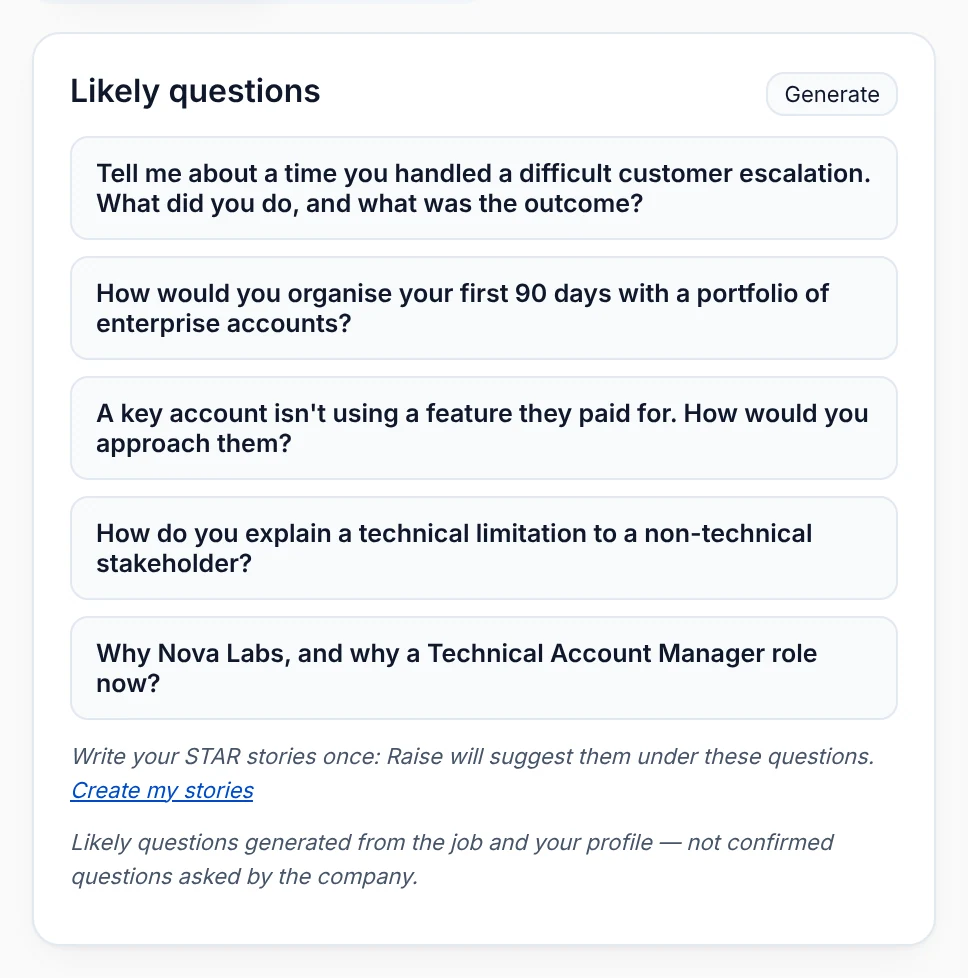
Seven role-plays put you face to face with a fictional persona generated by AI: an escalating client, a skeptical prospect, a partner pushing on terms, a recruiter screen, the hiring manager, a client with a delayed rollout, and the negotiation of your offer.
- Turn by turn. The persona answers each of your replies. Feedback comes when you finish.
- Your pick of style. When a scene offers it: rushed, friendly or skeptical.
- Fictional, and said so. A role archetype, never a real person from the company.
Methods and exercises
Methods you can reuse in every interview.
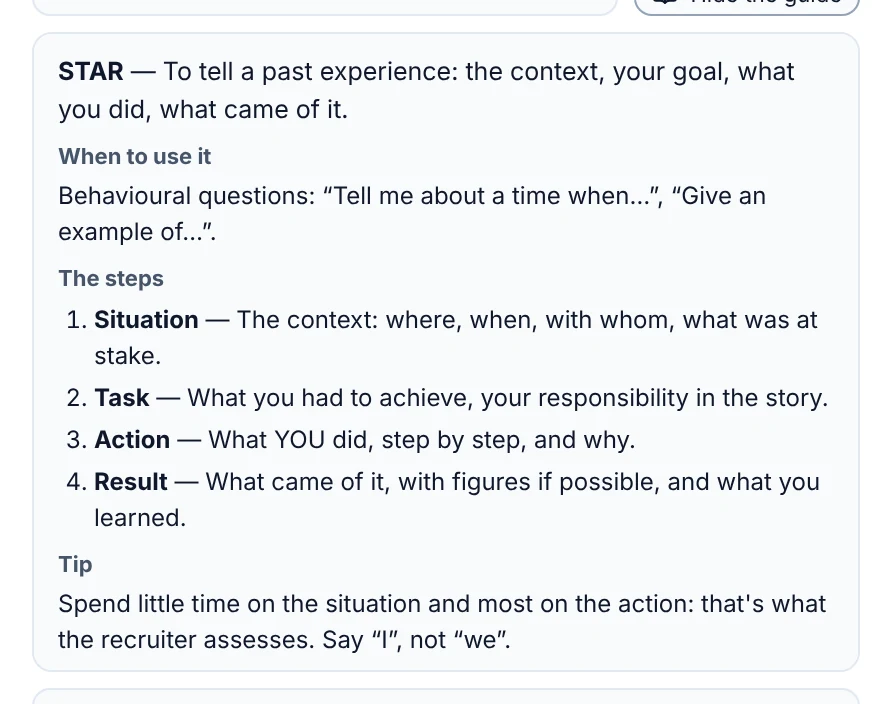
Short guides to STAR, CAR, the Minto pyramid, MEDDIC and SPIN: when to use each one, and its steps. Then practice on business cases and presentations.
- Six business cases. An account at risk, a portfolio to prioritise, a discount request and more.
- Six presentations. From your 90-day plan to a five-minute product demo.
- Company formats. For companies such as Amazon, Google and Microsoft, a summary of how they describe their own interviews, with a link to the source. See them below.
Interview formats, from the companies themselves
Some companies publish how they interview. Raise summarises these pages in the app, with a link to each source. Read the source before your interview: formats change.
- AmazonA series of one-on-one interviews with employees (the “interview loop”), focused on behavioral questions guided by the Leadership Principles; the STAR method is suggested to structure answers.Source: Interview Loop, amazon.jobs
- GoogleA panel of interviews (video or in person) with several Googlers; structured interviews scored with clear rubrics, role-related open-ended questions on how you solve problems, no brain teasers.Source: Our hiring process, google.com
- MicrosoftYou may meet future teammates and cross-functional colleagues; some roles include coding exercises, a portfolio review or work samples. Microsoft recommends the STAR(R) model and focuses on culture aspects such as growth mindset.Source: Interview tips, careers.microsoft.com
- NVIDIAFor full-time roles, phone interviews followed by virtual or in-person interviews; one-on-one, small-group or panel interviews of 30–60 minutes each, and possibly a coding exercise for technical roles.Source: How We Hire, nvidia.com
- SalesforceBehavioral, competency-based or situational questions about real-life situations; most conversations happen virtually on Google Meet, and an on-site interview is required before an offer.Source: How We Hire at Salesforce, salesforce.com
- AccentureInterviews by phone, video or in person, their number depending on the role; for some roles, an online activity assesses technical skills, natural strengths and decision-making (Accenture US site).Source: Recruiting and Hiring Process, accenture.com
- CapgeminiInterviews by phone, video or in person, possibly combining behavioral, technical and cultural-fit interviews and assessments; prepare examples of your work, problem-solving and collaboration.Source: Recruitment process, capgemini.com
- Boston Consulting GroupFor client-facing roles, the case interview is a key step: a realistic business problem to work through step by step (structure the approach, ask questions, analyze data). The page only covers the case interview.Source: Case interview preparation, careers.bcg.com
- BNP ParibasThe number of steps varies by job, but there are always at least two interviews, sometimes more and/or tests; BNP Paribas advises illustrating each skill in the job description with real-life situations. Page from the BNP Paribas Finland site.Source: Your career path, finland.bnpparibas.com
- SanofiA screening call (usually by phone) with the recruiter; interviews may include a semi-structured panel. Sanofi uses behavioural interviewing and points to the S.T.A.R. methodology.Source: Recruitment Process, jobs.sanofi.com
Summaries written by Raise from each company’s own page. Links checked on 28 October 2026.
What Raise does not do
A practice tool, with clear limits.
- No help during a real interviewRaise is for practice before it, never a live assistant during it.
- No scoreNo mark out of 10 or 100, on any answer.
- No voice or video analysisRaise reads what you type. It never analyses your voice or your face.
- No real recruiterEvery persona is fictional, generated by AI, and labelled that way.
Questions about the mock interview
Is the AI mock interview free?
Yes, it is part of the Free plan.
What do the paid plans add?
Higher limits. Pro costs €10 a month and Max €20 a month, billed month to month, and you can cancel at any time. See the plans on the pricing page.
How do I answer?
You type your answer the way you would say it, at your own pace. The feedback is written on that text.
Which interviews can I prepare for?
A recruiter call, an interview with the hiring manager, a business case or a presentation, and the negotiation of your offer, for any job you add.
Which roles is it written for?
The likely questions and the feedback work from any job ad. The role-plays and business cases are written for client-facing roles: customer success, account management, pre-sales and partnerships.
Where is my data kept?
In the European Union, in Ireland. You can export all of it as a JSON file from your account at any time.
Can I use it on my phone?
Raise is built for a computer and runs in the browser, with nothing to install. On a phone, you can create your account; Raise itself is used on a computer.
Your next interview, rehearsed.
Create your account: Raise runs in your browser, with nothing to install.